


In Time: Could Have Been Better, Should Have Been Better
- Fraser Simpson

- Aug 18, 2025
- 4 min read
Andrew Niccol's In Time is an average film with a premise that deserves a better film, and here's why the film shows the wasted potential of such a premise.
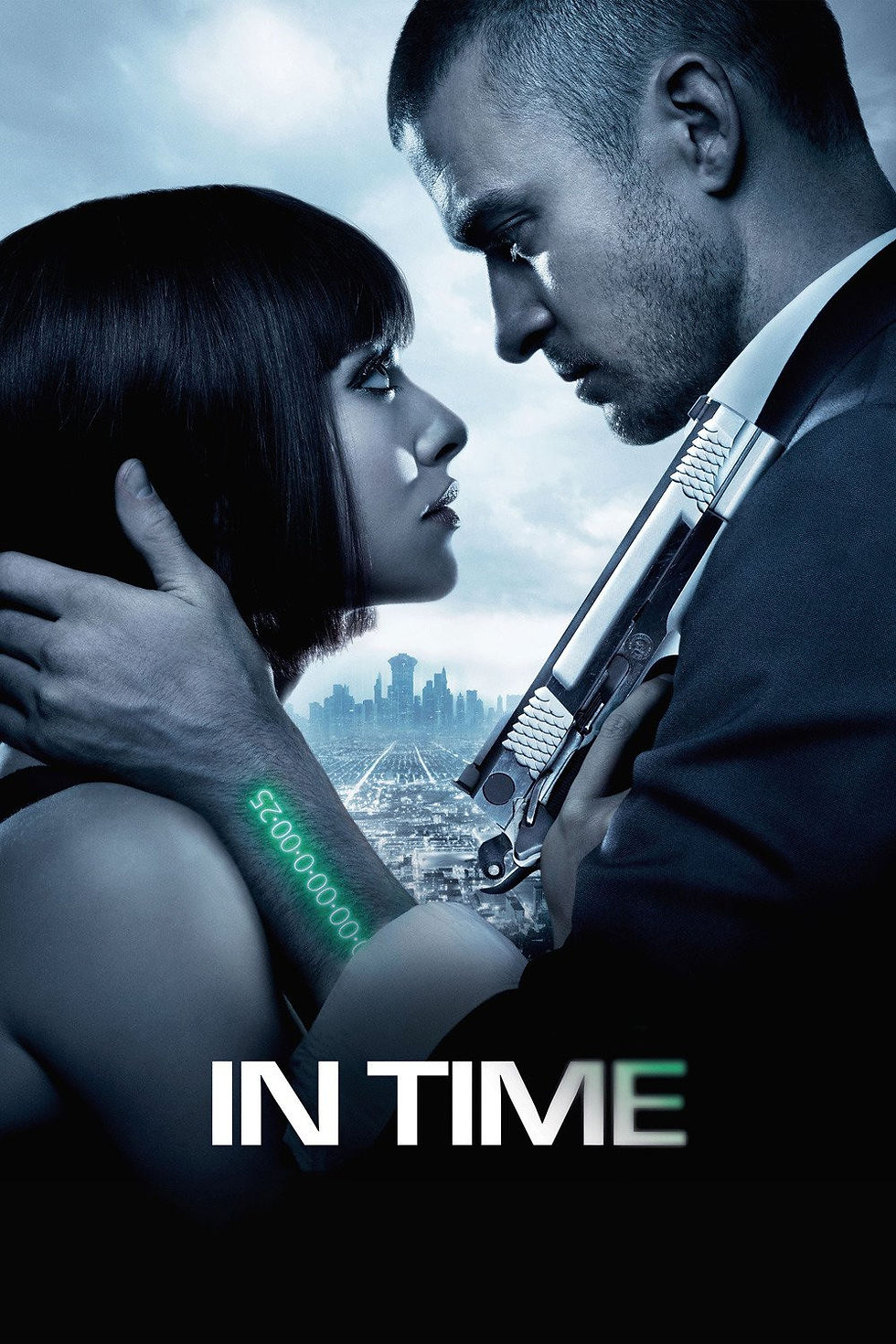
In Time is a film that arguably could benefit from a remake or reimagining—anything that could do its premise justice. It features a fascinating premise: a near-future where people stop ageing at 25, and time becomes the main currency for everything. This idea is similar to the premise of Logan’s Run, in which a fictional dystopian society maintained a balanced population and resource use by killing everyone who reached the age of 30. Despite its impressive premise, In Time barely explores it in any meaningful manner, and while it isn't a bad film in the slightest, it could have been something truly extraordinary if it had explored its premise to its fullest potential.
To elaborate further on In Time's premise, in 2169, people are genetically engineered to stop ageing on their 25th birthday, when a one-year countdown on their forearm begins (the reason for such genetic engineering is never revealed). When it reaches zero, the person "times out" and dies instantly. Due to this, those living in the richest time zones are effectively immortal, whilst those in the poorest time zones, like the manufacturing 'ghetto' Dayton, where Justin Timberlake's 28-year-old factory worker Will Salas works, barely have enough time to scrape by.
It’s not out of the question to have expected more from In Time. After all, writer and director Andrew Niccol’s previous experience included writing the acclaimed The Truman Show and directing Gattaca as his feature film debut, another dystopian sci-fi film. Niccol himself stated that In Time is a "bastard child of Gattaca", as both films feature a caste privilege schism, which the protagonist challenges and which prejudices the authorities into neglecting a thorough investigation in favour of condemning the protagonist. Yet, In Time has nothing as thought-provoking compared to Gattaca’s themes on eugenics and concerns over reproductive technologies that facilitate those eugenics, nor The Truman Show and its prescient vision of a country with an insatiable thirst for the private details of ordinary lives.
In Time's issues aren't solely down to its wasted potential. Justin Timberlake is inconsistent as the film's action hero, and it wouldn't be out of the question to jokingly think he was cast partially because his name is close to the film's title. Amanda Seyfried doesn't fare much better as Mr Timberlake's partner in crime and love interest, as both attempt to level the corrupt system, and both their acting and the characters they play feel less charismatic and compelling than two walking breadsticks. Despite these two not being the best fit, In Time's wasted potential is the main takeaway most people will likely have after watching the film. Whilst there is a strong political message hidden behind the time puns and futuristic technology, In Time chooses to focus more on poorly executed action sequences, involving robbing time banks, fistfights, and car chases that may feature one of the most obviously bad CGI car flips in cinematic history.

It’s not all bad. Cillian Murphy likely deserved better as the main villain, a police-like timekeeper who upholds the system, having escaped from Dayton, where he was born and raised, but at least his leather jacket outfit is cool, and his performance is about what you'd expect from the future Oscar winner. Perhaps in a better film, his conflict could be split between his wish to uphold the system and wanting Justin Timberlake’s character to succeed despite his background, just as he did. There’s also a brief but fun plot point where two men arm wrestle each other to the death, and it serves as a glimpse into the neat ideas the film could’ve presented, instead of the ideas it ultimately ended up presenting. And of course, the premise. Regardless of whether people like the film or find it to be wasted potential, the premise is generally considered to be promising. Whilst many people, myself included, find that its premise wasn't explored to its fullest capacity, it's perfectly understandable to see why people would derive enjoyment from this film solely because of its premise.
However, it’s interesting to see how, after nearly 14 years since its release, In Time’s main talking point revolves around what could’ve been, and with a premise as interesting as time being currency, how it should’ve been better. It’s a shame, not least because more people should know how fun it is to watch two people arm wrestle each other to death, but because there’s a brilliant film hiding somewhere beneath Justin Timberlake’s poor performance and the copious amount of time puns. Perhaps one day someone will revisit this general premise, whether in a book, TV series, or another film, and deliver something truly special. Until then, we’ll have In Time as an interesting, if underdeveloped, proof of concept.


Comments